

· AFX Research
Slayer Statutes and Real Property Title Research, 7 Checks
A slayer statute can strip a survivor's interest in real property years after the deed recorded. What the land record shows, and what it never will.

Table of Contents
Every state has some version of a slayer statute — a rule that a person who feloniously and intentionally kills another cannot take property from the victim. Most practitioners meet it in a life insurance context. Its sharpest effects, though, land on real property, because the instruments it defeats are recorded, public, and perfectly clean on their face.
A deed held in joint tenancy with right of survivorship does not announce that one joint tenant killed the other. The survivor’s name is on the record, the vesting language is standard, and a search of the parcel returns a result that looks settled. The slayer statute operates outside that record entirely.
How the statute interacts with vesting
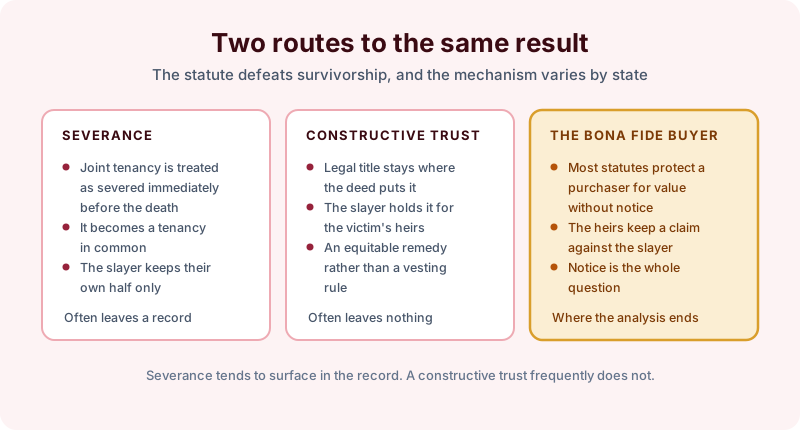
The analytical difficulty is that a survivorship interest is not a transfer at death in the ordinary sense. It is an interest the survivor already held, which simply swells to the whole on the other’s death. Legislatures and courts have handled that in two broad ways.
- Severance. Many statutes treat the killing as severing the joint tenancy immediately before the death, converting it to a tenancy in common. The slayer keeps their own half; the victim’s half passes through the victim’s estate.
- Constructive trust. Other states leave legal title where the deed puts it and impose a constructive trust on the slayer in favor of the victim’s heirs — the mechanism described in constructive trusts and real property title research.
The practical difference matters to a searcher. Severance tends to produce a recorded instrument at some point. A constructive trust frequently produces nothing recorded at all until somebody litigates.
Transfer on death deeds, life estates, elective share claims and entireties property each bend the analysis again, which is why this sits so close to tenancy by the entirety and creditor claims and to joint tenancy severance and survivorship.
Why the land record is silent
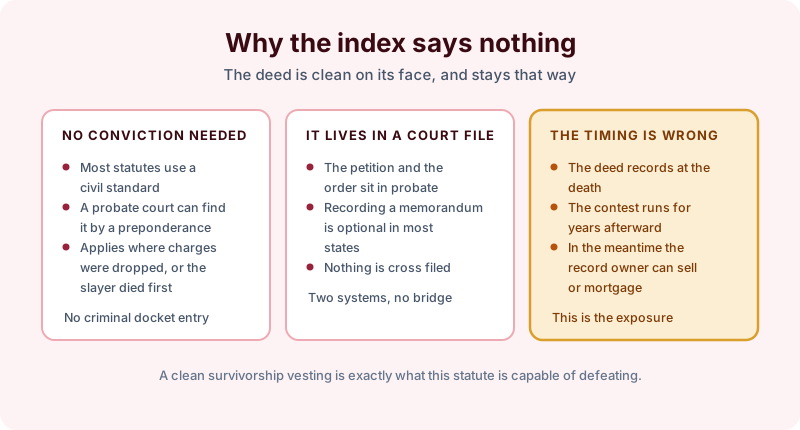
Three features of these statutes keep them out of the grantor and grantee indexes.
First, most of them do not require a criminal conviction. The usual standard is a civil finding by a preponderance of the evidence in probate court, which means the statute can apply where there was never a prosecution, where charges were dropped, or where the slayer died before trial.
Second, the finding is made in a court file rather than in the land records, and recording a memorandum of it is not mandatory in most states.
Third, the timing is wrong for a searcher. A probate contest can run years after the survivorship deed was recorded, and in the meantime the record owner may have mortgaged or sold the property.
7 checks when a death is in the chain
-
Read the vesting line on the deed that created the survivorship, not the summary in a report. Joint tenancy, entireties and community property with right of survivorship behave differently under most slayer statutes.
-
Pull the probate file for the decedent, including any petition to determine heirs, any will contest and any slayer petition. This is where the finding lives, and it is the same discipline that probate property title research applies generally.
-
Search the criminal and civil dockets by name. A conviction is strong evidence but not a prerequisite; a pending civil action against the survivor may be the only signal available.
-
Check for a recorded affidavit or order. Where counsel for the victim’s heirs is competent, a certified copy of the probate order or a lis pendens will be recorded against the parcel. That turns an invisible claim into a visible one, and lis pendens in a title search covers how it reads.
-
Identify any intervening purchaser or lender. Most slayer statutes expressly protect a bona fide purchaser for value without notice, which can cut off the heirs’ claim against the property while leaving them a personal claim against the slayer for the proceeds. Whether a particular buyer qualifies turns on notice, and that analysis runs through bona fide purchaser status.
-
Trace where the victim’s share would go. Slayer statutes generally treat the slayer as having predeceased the victim, so the share passes to the next taker. Anti-lapse rules and representation can route it to the slayer’s own children, which surprises people.
-
Watch the elective share and homestead interactions. A surviving spouse barred as a slayer is usually barred from the elective share and homestead rights as well, a question that connects to elective share and surviving spouse rights.
What a search establishes, and what it does not
Be precise about the boundary here, because clients are not. A records search reports what was recorded and found in the indexes reviewed, in the county searched, over the term searched. It can establish how title was vested, when the survivorship deed recorded, what has been filed against the parcel since, and whether any order, affidavit or lis pendens appears of record.
It cannot establish that a killing occurred, that it was felonious and intentional, or that a slayer statute applies. Those are legal conclusions for counsel and for a court. An absence of any recorded instrument does not mean no claim exists, and recording practice varies county by county.
That limit is the reason a document-level search is worth more than a summary here. The deed’s own vesting language, the recording date and any later instrument are the raw material counsel needs, and a report that paraphrases them is not a substitute.
How AFX Research fits into this
These chains reward a searcher who returns instruments rather than conclusions. AFX Research performs in-person searches, certified abstracts, and full document copies from any U.S. county — delivered in 12 to 72 hours and backed by our search guarantee — so the vesting deed, the later conveyances and anything recorded against the parcel arrive together with copies attached.
Order a title search naming the parcel and both parties, or compare our search products if you are weighing a current owner search against a full chain for an estate dispute.