

· AFX Research
Constructive Trusts and Real Property, 7 Title Research Checks
A constructive trust is a remedy a court imposes, not an instrument anyone records. What the chain still proves, and why timing is the strongest evidence.

Table of Contents
- It is a remedy, not an instrument
- What the chain can still show
- Seven checks worth running
- 1. Pull the vesting deed and every instrument around the purchase
- 2. Identify who the lender treated as the borrower
- 3. Date everything against the relationship
- 4. Search for a recorded declaration of trust or side agreement
- 5. Run the title holder’s name for liens
- 6. Check for conveyances out
- 7. File the lis pendens, then keep searching
- What the record can and cannot settle
- Ordering the abstract behind the claim
A client paid for a property, let a relative take title for a mortgage reason that made sense at the time, and now the relative is treating it as their own. There is no written agreement. There is nothing recorded. The remedy counsel reaches for is a constructive trust, and the evidence it runs on is almost entirely in the land records — which is a useful thing to know, because nothing in those records will ever mention a trust.
It is a remedy, not an instrument
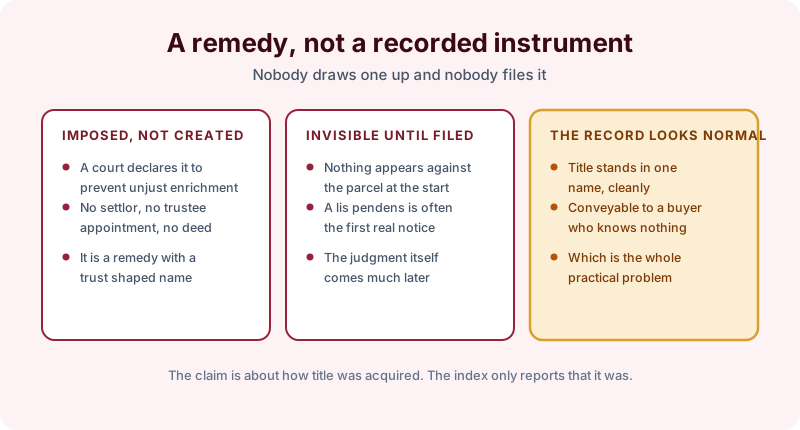
Nobody creates a constructive trust. A court imposes one, to prevent unjust enrichment, by declaring that the person holding legal title holds it for somebody else’s benefit. There is no settlor, no trust instrument and no deed into trust. The name is borrowed from a thing it is not.
Until a filing is made, the record shows nothing. A lis pendens is usually the first notice anyone gets, and it comes only once a suit exists. Before that the parcel looks entirely ordinary and is conveyable to a buyer who knows nothing, which is the whole practical problem and the reason the filing is urgent — the exposure is the one described in bona fide purchaser status.
What the chain can still show
These claims are close relatives of the arrangement examined in nominee and straw party deeds, where title is deliberately placed in somebody else’s name. The difference is that there, everyone agreed at the time.
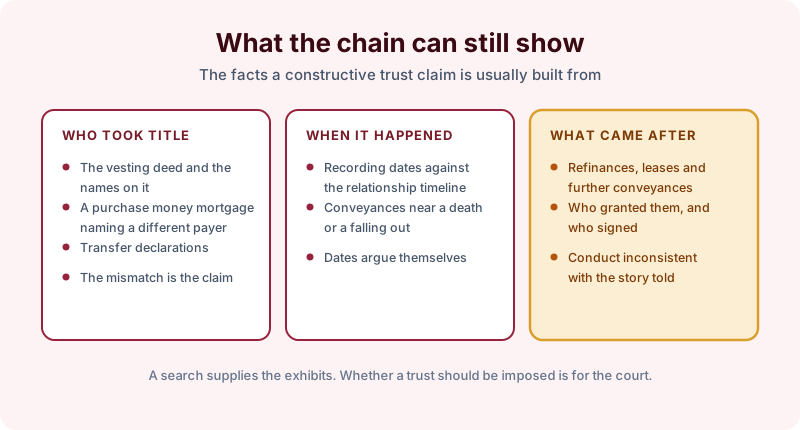
Who took title, against who paid. The vesting deed names one person. A purchase money mortgage naming somebody else as borrower, or a transfer declaration, or a deed from a seller who was paid by a third party, is the mismatch the claim is built on.
When it happened. Recording dates set against the relationship timeline. A conveyance a fortnight before a wedding, a month after a death, or during a business falling-out carries meaning that no witness has to supply.
What came after. Refinances, leases and further conveyances show how the title holder actually behaved. Somebody who granted a mortgage and kept the money was not holding for anyone else, and somebody who never collected rent may have been.
Seven checks worth running
1. Pull the vesting deed and every instrument around the purchase
Not the index entry. The deed, the mortgage, the releases, and anything recorded the same week.
2. Identify who the lender treated as the borrower
A purchase money mortgage is the cleanest contemporaneous record of who was putting up money.
3. Date everything against the relationship
Build one timeline with recording dates on it. This is the part that persuades.
4. Search for a recorded declaration of trust or side agreement
Occasionally one exists, recorded years later by a party who wanted protection and did not want a dispute. If it does, the case is a different and much easier one, closer to the straightforward reading in trust-owned property title research.
5. Run the title holder’s name for liens
A judgment against the record owner attaches to property a court may later find they hold for your client, which is the collision also present in fraudulent transfer research.
6. Check for conveyances out
A transfer to a third party changes the remedy from recovering the property to tracing its proceeds. Timing decides which, and so does whether the buyer had notice, which is the same analysis that governs a wild deed.
7. File the lis pendens, then keep searching
A notice protects the claim going forward. It does nothing about what was recorded before it.
What the record can and cannot settle
A search establishes who holds title, what was recorded, when, and by whom, with copies attached. It cannot establish intention, an oral promise, or whether a confidential relationship existed — and those are the elements. The record is circumstantial evidence of them, which is frequently the best evidence available once memories have diverged. Nor does it decide whether a constructive trust should be imposed, which is for the court. Recording practice varies by county, and an empty result is not proof that nothing exists.
What it does is convert a dispute about what people remember into a set of dated documents, which is a considerably stronger position.
Ordering the abstract behind the claim
These cases turn on the instruments around a single purchase, so full document copies rather than an index summary are what matter. AFX Research runs in-person searches, certified abstracts, and full document copies from any U.S. county — delivered in 12–72 hours and backed by our search guarantee.
Order a title search naming the parcel and every party to the purchase, or compare our search products to pick the term that reaches the transaction in question.