

· AFX Research
Purchase Money Mortgage Priority in Attorney Title Research
Why a loan that buys the property can outrank liens already against the buyer, and what to verify in the record before relying on it.

Table of Contents
- The rule and the exception
- Where the doctrine is argued
- Seven things to pull before relying on it
- 1. The judgment docket against the buyer
- 2. The recording times, not just the dates
- 3. The closing statement and the funding record
- 4. Any prior mortgage being paid off
- 5. Whether a docketed judgment was still alive
- 6. Assignments of the competing liens
- 7. The state’s own rule
- What the search settles and what it does not
- How AFX Research can help
Your client bought a house in March. In 2019 a creditor docketed a judgment against them for an old business debt, and that judgment has been sitting in the county ever since, attaching automatically to any real property your client acquires there. The purchase closed with a bank loan. Which comes first — the 2019 judgment or the 2026 mortgage?
Under recording acts and priority, first in time usually wins, and the judgment would appear to outrank the mortgage that funded the purchase. The purchase money doctrine says otherwise, and it is one of the oldest exceptions in American property law.
The rule and the exception
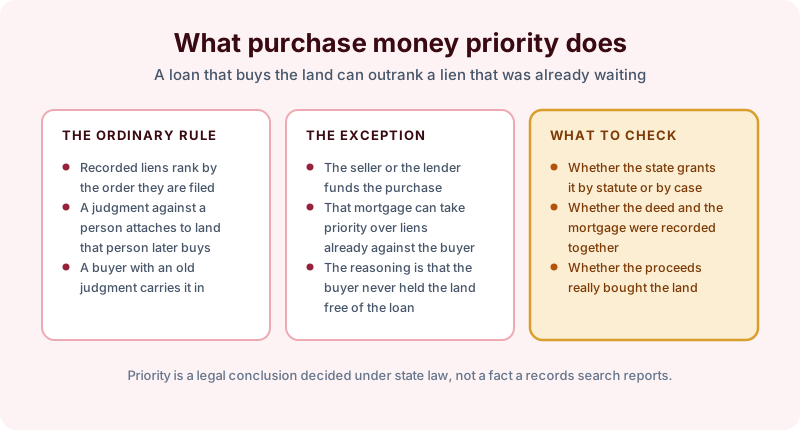
The ordinary rule is mechanical. Recorded liens rank by filing order, and a docketed judgment against a person attaches to real property that person later acquires in that county. A buyer carrying an old judgment carries it into every closing.
The purchase money exception interrupts that. Where the seller or a lender advances the money that buys the property, that mortgage can take priority over liens already outstanding against the buyer. The reasoning is older than the statutes — the buyer never held the land free of the obligation, because the deed and the mortgage were one transaction, and a judgment creditor who had nothing to attach the day before should not be enriched by a purchase their money did not fund.
Where the doctrine is argued
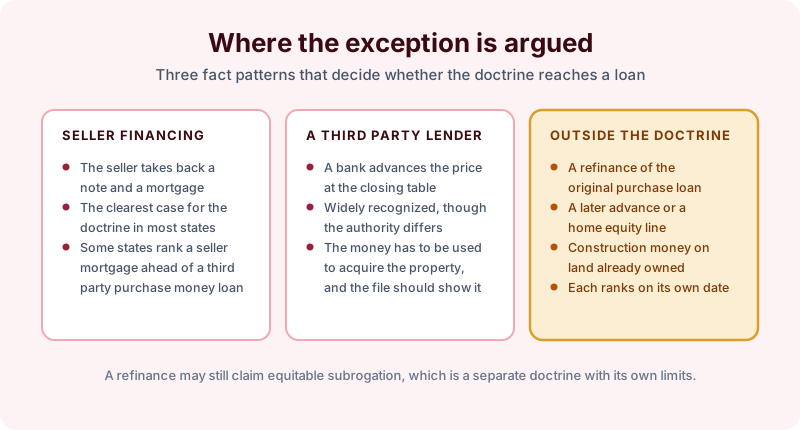
Seller financing is the clearest case. The seller takes back a note and a mortgage, and in most states the doctrine protects it squarely. Several states go further and rank a seller’s purchase money mortgage ahead of a third party purchase money loan on the same closing, which matters when both exist — a pattern worth tracing alongside contract for deed title research, where the financing and the conveyance are the same instrument.
A third party lender advancing the price at the table is widely recognized, though the authority differs in strength from state to state, and the burden sits on showing the money bought the land.
Outside the doctrine are the ones attorneys misclassify. A refinance of the original purchase loan is not purchase money. Neither is a later advance, a home equity line, or construction money borrowed against land the client already owned. Each ranks on its own recording date. A refinance may still reach the same result through equitable subrogation, but that is a separate doctrine with its own requirements and its own failure modes.
Seven things to pull before relying on it
1. The judgment docket against the buyer
Every judgment, state tax warrant and child support lien docketed against your client before the closing, under every name variant. A lien the search was not told to look for is a lien nobody evaluated.
2. The recording times, not just the dates
The deed and the mortgage should read as one transaction. A mortgage filed weeks behind the deed invites the argument that the two were separate events.
3. The closing statement and the funding record
These are what show the proceeds actually acquired the property. They are not in the land record, and they belong in the file anyway.
4. Any prior mortgage being paid off
If part of the money retired an existing lien rather than buying the land, the analysis splits, and subrogation rather than purchase money may be doing the work.
5. Whether a docketed judgment was still alive
A dormant judgment that was never revived may have lapsed before the closing, which moots the question entirely.
6. Assignments of the competing liens
The party you will be negotiating with is often not the party named on the original filing.
7. The state’s own rule
Whether the priority comes from statute or case law, and whether it has been narrowed as to third party lenders. The variation between states is real.
What the search settles and what it does not
What the search gives you is the sequence — every encumbrance docketed against the buyer before the closing, the deed, the mortgage, their recording times, and any assignment since. What it does not give you is the answer. Priority is a legal conclusion under the law of the state where the land sits, and the abstract exists so that the conclusion rests on something. Recording and docketing practice varies county by county, and a judgment indexed under a name variant is one the search has to be told to find.
Three situations put real money on this. A buyer with existing judgment creditors, where the lender’s position depends entirely on the doctrine holding. A seller carrying back financing who assumes they are first and never checks. And a title claim after the fact, where the question becomes what the examiner should have caught at closing — the scenario behind most of what attorneys miss in title reports.
How AFX Research can help
We run in-person searches, certified abstracts, and full document copies from any U.S. county, delivered in 12 to 72 hours and backed by our search guarantee, which is what makes a priority analysis something other than guesswork.
Order a title search on the buyer and the property together, or compare our search products to match the scope to the closing.