

· AFX Research
Omitted Junior Lienholders After a Foreclosure Sale
What happens when a junior lienholder is never joined in a foreclosure, why the lien survives the sale, and the record work behind every cure.

Table of Contents
A client buys at a foreclosure sale, records the deed, puts money into the property, and two years later receives a notice of default from a second mortgage holder nobody told them about. The foreclosure that produced their title was valid. The sale was not void. And the lien is still there, because the holder was never made a party to the case.
This is the quiet failure mode behind junior lien foreclosure work, and it is almost always a search problem before it is a litigation problem.
Why the lien survives
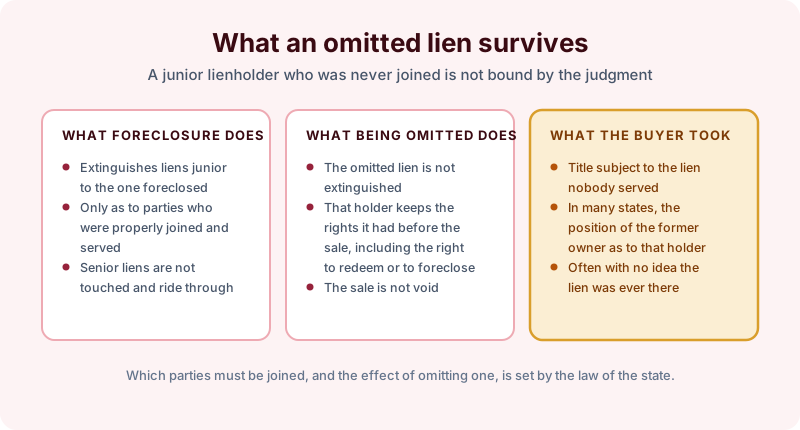
A foreclosure extinguishes liens junior to the one being foreclosed — but only as to parties who were properly joined and served. That qualifier is the whole doctrine. Senior liens are not touched and ride through regardless.
An omitted junior lienholder keeps every right it held the day before the sale, including the right to redeem and the right to foreclose its own lien. Due process is the reason, and it is not a technicality a court is likely to overlook. The sale itself usually stands. What the purchaser took is title subject to the lien nobody served, and in many states the purchaser steps into the position the former owner occupied as against that holder.
Most buyers at a foreclosure sale have no idea any of this happened, because the chain reads as a completed foreclosure.
How the omission happens
Rarely through carelessness alone. The usual causes are structural, and each one is a gap in what the foreclosing party was looking at rather than a gap in what existed.
- A lien recorded shortly before the complaint and not picked up by a search run earlier in the process.
- A lien indexed under a variant name, an abbreviated entity, or a misspelling, which the foreclosing party’s search never surfaced.
- An assignment never recorded, so the party served was no longer the holder.
- A lien in a different index — a municipal charge, a state tax warrant, or a mechanics lien filed in a register the examiner did not reach.
- A federal lien with its own notice requirement and a statutory redemption period of its own.
Every one of those is a records failure that a complete search at the right moment would have caught.
How it is cured
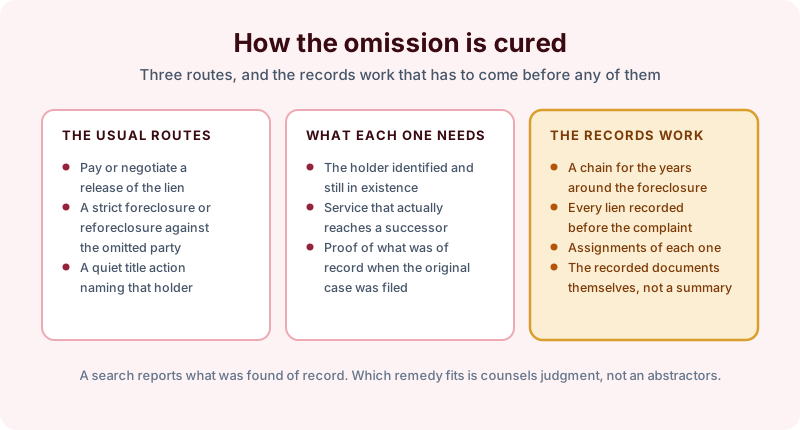
Three routes, in rough order of expense. Pay or negotiate a release, which is often cheapest where the lien is small and the holder is findable. Bring a strict foreclosure or a reforeclosure against the omitted party, which is the remedy several states provide by statute precisely for this. Or bring a quiet title action naming that holder.
Each requires the same three things. The holder identified and still in existence. Service that actually reaches a successor, which means tracing assignments and corporate changes. And proof of what was of record on the day the original complaint was filed, since that is the date the joinder question turns on.
The record work behind the cure
What any of these remedies rests on is a chain covering the years around the foreclosure, every lien recorded before the complaint was filed, the assignments of each one, and the recorded instruments themselves rather than a summary. A judgment index entry does not establish who holds the lien today, and a foreclosure complaint does not establish who was of record when it was drafted.
What a search reports is what was found of record over the term ordered. Which remedy fits, whether the omitted lien is actually enforceable, and what a redemption would cost are legal conclusions for counsel in that state. Recording and indexing practice varies county by county, and an empty result in one index is not proof that nothing was filed in another.
Where this surfaces in practice
On resale, when the next buyer’s examiner finds what the first one missed. On a title claim, where the question is whether the omission was discoverable. On a tax deed purchase, where the notice requirements are stricter still and the omitted party may be a prior mortgagee. And in loss mitigation, where a servicer discovers that the asset it believed it owned free of junior liens is not.
In each case the fix begins the same way, with a search that establishes the record as it stood on a specific date rather than as it stands today. That distinction is the point. A current owner report answers what encumbers the property now, and it will not tell you who should have been served in a case filed four years ago.
How AFX Research can help
We run in-person searches, certified abstracts, and full document copies from any U.S. county, delivered in 12 to 72 hours and backed by our search guarantee, which is what makes a dated reconstruction of a foreclosure file possible at all.
Order a title search covering the foreclosure period, or compare our search products to match the term to the case.