

· AFX Research
Federal Estate Tax Liens and Real Property Title Research
The federal estate tax lien is never filed, never indexed, and never returned by a name search. Here is where the question actually lives.

Table of Contents
- Why the land record cannot answer this question
- Where the question actually lives
- 1. A date of death
- 2. Whether a return was required
- 3. An inventory listing the real property
- 4. Orders authorizing a sale
- 5. Recitals in the deed itself
- 6. Non-probate transfers
- 7. Any discharge or release that was obtained
- What this means for the closing
- How AFX Research can help
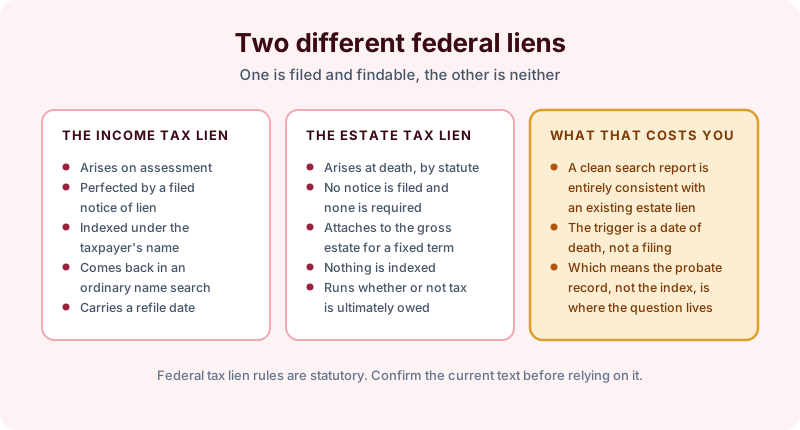
Every real estate attorney knows to run a federal tax lien search. Almost every one of them is thinking of the general tax lien under the income tax provisions — assessed, then perfected against third parties by a notice filed in a county office, indexed under the taxpayer’s name, and returned by an ordinary search. It behaves exactly like a judgment, which is why it causes so little trouble.
The federal estate tax lien is a different animal entirely, and the difference is not one of degree. It arises by operation of law at the moment of death, attaches to the property included in the gross estate, runs for a fixed statutory period, and requires no filing of any kind. Nothing is recorded, so nothing is indexed, so nothing comes back. A title search that returns a clean federal lien result is perfectly consistent with an estate lien sitting on the very parcel you are about to close.
Why the land record cannot answer this question
The recording system is built around the idea that an interest is perfected by being written down somewhere a stranger can find it. The estate tax lien is one of the handful of federal interests that opts out of that bargain. Its priority does not depend on notice to anyone, which means the county has no role in it and the index has nothing to say.
That is a structural problem rather than a research failure, and it is worth being precise about it with clients. When our report comes back showing no federal tax liens found of record, the honest reading is that no notice of lien was filed. It is not a statement that no federal lien exists. The same distinction runs through our guide to federal tax lien title research, and this is the sharpest version of it.
Where the question actually lives
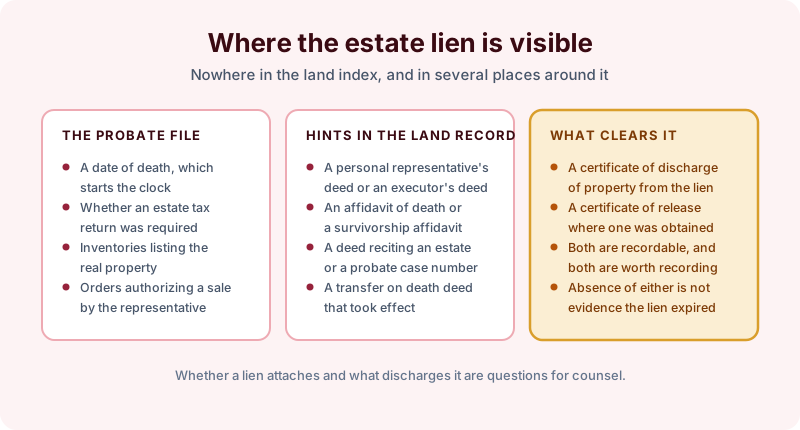
If the index cannot answer it, the probate file usually can, and the land record will at least tell you to go looking.
1. A date of death
Everything starts here, because the lien runs from death rather than from an assessment or a filing. Without a date you cannot even say whether a statutory period has run.
2. Whether a return was required
Most estates never approach the filing threshold. The lien attaches regardless of whether tax is ultimately owed, but the practical exposure is very different for an estate that had to file and one that did not.
3. An inventory listing the real property
Probate inventories tell you whether the parcel was part of the gross estate as the representative understood it. They are not conclusive, and property passing outside probate is exactly what they miss.
4. Orders authorizing a sale
A representative selling under court order leaves a record of what the court thought it was approving.
5. Recitals in the deed itself
A personal representative’s deed, an executor’s deed, an affidavit of death, a survivorship affidavit, a transfer on death deed that took effect — each of these is a flag in the land record that a death sits in the chain, even though none of them mentions a lien.
6. Non-probate transfers
Joint tenancy property, beneficiary deeds and trust distributions frequently never touch a probate file at all, which is the hardest version of the problem. A survivorship affidavit may be the only document in the county that records the death.
7. Any discharge or release that was obtained
A certificate of discharge of property from the lien, or a certificate of release, is recordable and is worth recording. Its absence proves nothing, but its presence settles a great deal.
What this means for the closing
The risk falls on a purchaser or lender who takes the property while the statutory period is still running. Whether the lien follows the property into their hands, and on what conditions, is a federal question that turns on the statute and on facts outside the land record. It is squarely a matter for counsel, and it is one of the cleaner examples of why a records search and a legal opinion are different products.
Practically, the work divides. We can establish what the county holds — the chain, the recited deaths, the probate case numbers, every lien and encumbrance found of record, and any discharge that was recorded. What the county cannot establish is whether an unfiled federal interest exists, and nobody should represent otherwise. The probate and estate side is the same ground our note on probate property title research covers, and the surviving spouse angle sits in our note on elective share rights.
Two further points worth flagging for an estate file. Recording and indexing practice varies county by county, so a death recited in one county’s record may be invisible in the neighboring one where a second parcel sits. And an empty search result is not proof that nothing exists — it is proof that nothing was found of record over the term searched.
How AFX Research can help
AFX Research runs in-person searches, certified abstracts, and full document copies from any U.S. county, delivered in 12 to 72 hours and backed by our search guarantee. On an estate file that means the chain, the recited deaths, the probate case references and the recorded discharges, pulled as documents rather than summarized from an index — which is what your deed retrieval and elder law and Medicaid planning matters usually need anyway.
Order a title search for the parcel and the decedent, or compare our search products if you are scoping a larger estate.