

· AFX Research
Deeds From Minors and Voidable Conveyances in Title Research
A deed signed by a minor is usually voidable rather than void, and nothing in the county record states anyone's age. Here is where the signal is.

Table of Contents
- Voidable, not void, and why the distinction decides everything
- The record states no age
- Where to look
- 1. How title arrived
- 2. Affidavits of heirship naming issue
- 3. Guardianship and conservatorship filings
- 4. Court orders authorizing a sale
- 5. A bond filed with the probate court
- 6. Custodial and trustee conveyances
- 7. Dates against dates
- What a search establishes, and what it does not
- How AFX Research can help
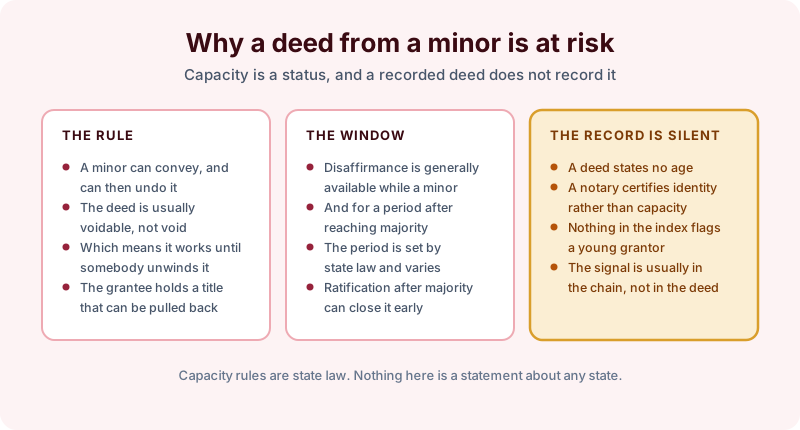
Capacity defects are the quietest title problems there are, because the record is organized around instruments and capacity is a fact about a person. A deed signed by someone under the age of majority looks like every other deed in the book. It was signed, it was acknowledged, it was recorded, and the index entry is unremarkable. What makes it dangerous is that in most states it is voidable — not void — which means it works until somebody chooses to unwind it, and the person who can do the unwinding has a window that may extend years past the closing.
Voidable, not void, and why the distinction decides everything
A void deed is a nullity. It conveyed nothing, it never could, and no subsequent purchaser improves the position, which is the ground our note on forged and void deeds works through.
A voidable deed is live. It conveyed title, the grantee can convey onward, and the chain reads normally — right up to the moment the former minor disaffirms. Then the question becomes what happens to everyone downstream, which is where bona fide purchaser status starts doing the work, with the complication that a purchaser’s good faith does not always defeat a disaffirmance.
The window is set by state law and it is not uniform. The general shape is that disaffirmance is available during minority and for some period after reaching majority. Ratification after majority can close it early, and so can the running of a limitations period. None of those dates is in the land record.
The record states no age
This is the whole of the research problem. A deed does not recite the grantor’s date of birth. A notarial certificate attests that the person appeared and was identified — it says nothing about capacity, as we set out in the general discussion of what an acknowledgment proves. The index carries names and dates of recording. Nothing anywhere flags a young grantor.
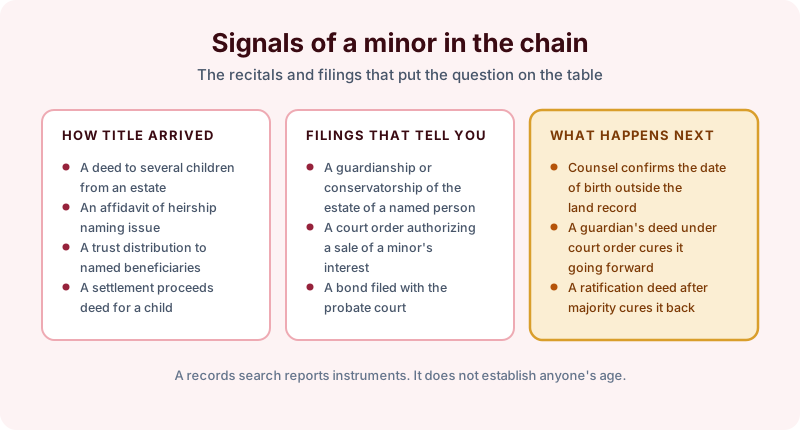
So the signal, when there is one, comes from the shape of the chain rather than from the deed itself.
Where to look
1. How title arrived
Minors almost never buy real property. They acquire it by inheritance, by trust distribution, by gift, or as the proceeds of a settlement. A deed out of an estate to several children of a decedent is the classic setup, and it is the same inheritance pattern our note on heirs property and tenancy in common addresses from a different angle.
2. Affidavits of heirship naming issue
An affidavit that names the decedent’s children is often the only document in the county that lists the people who took. Ages are not given, but names and relationships are, and a child named as issue in 2009 was not necessarily an adult in 2014.
3. Guardianship and conservatorship filings
A guardianship or conservatorship of the estate of a named person is the strongest signal in the record, and the one most likely to be sitting in a probate index rather than a land index. Our note on guardianship and conservatorship property sales covers the forward-looking version of this.
4. Court orders authorizing a sale
An order approving the sale of a minor’s interest tells you two things at once — that a minor held an interest, and that somebody did the work correctly.
5. A bond filed with the probate court
Routine, unglamorous, and frequently the only trace in the file.
6. Custodial and trustee conveyances
A deed to or from a custodian under a transfers to minors act, or from a trustee holding for a named beneficiary, is a capacity structure operating as designed. Its absence where you would expect it is the thing to notice.
7. Dates against dates
Where the chain gives you a year of inheritance and a year of conveyance a short distance apart, the gap is the question. Nothing in the record answers it, and that is precisely the point at which the file leaves our hands and enters counsel’s.
What a search establishes, and what it does not
We report the instruments found of record over the term searched, the recitals they carry, the probate and guardianship references that appear, and the court orders that were recorded. We pull documents rather than index summaries, because the recitals are where the names and the relationships are.
What a records search does not do is establish anyone’s age, confirm that a disaffirmance period has run, or determine whether a conveyance was effectively ratified. Those are legal conclusions on facts that live outside the land record. Recording and indexing practice varies by county, and a clean chain is never proof that no capacity defect exists.
How AFX Research can help
AFX Research runs in-person searches, certified abstracts, and full document copies from any U.S. county, delivered in 12 to 72 hours and backed by our search guarantee. On a capacity question that means the estate deeds, the affidavits of heirship, the recorded guardianship orders and the full recitals, retrieved as documents — which is the material property attorneys need before advising anyone to accept a chain like this.
Order a title search, or compare our search products if the matter covers several parcels.