

· AFX Research
Memoranda of Lease and Option, Title Research Attorney Checks
What a recorded memorandum puts on the record, what it deliberately leaves out, why purchase options hide inside them, and the four checks before clearing one.

Table of Contents
Commercial leases are long, their terms are confidential, and nobody wants them in a public index. So the parties record a memorandum instead — a one or two page instrument that announces the lease exists, identifies the premises, and stops there. The same device carries purchase options, rights of first refusal and development agreements. For an examiner it is the most frequently misread document in the chain, because it looks like a complete instrument and is designed not to be one.
What the memorandum puts on record
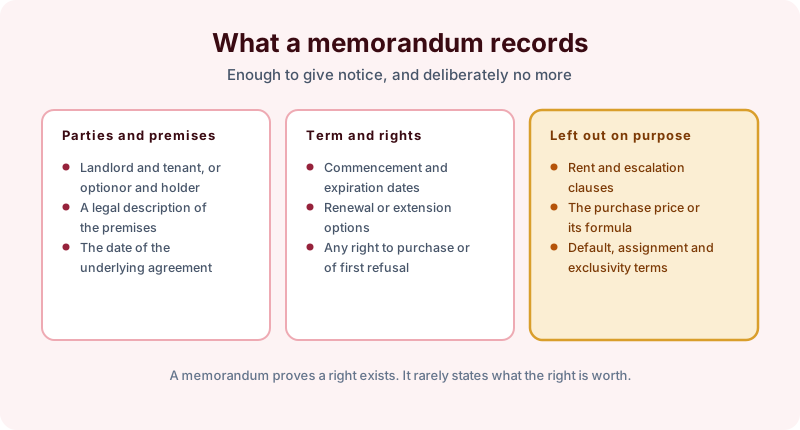
Three categories, reliably present in nearly every form.
- Parties and premises. Landlord and tenant, or optionor and holder, together with a legal description and the date of the underlying agreement.
- Term and rights. Commencement and expiration, renewal or extension options, and — the part that matters most — any right to purchase or right of first refusal buried in the lease.
- Signatures and acknowledgment. Executed and notarized to the same standard as a deed, which is what makes it recordable at all.
What is deliberately absent is everything commercial. Rent and escalations, the purchase price or its formula, default provisions, assignment and subletting rights, exclusivity and co-tenancy clauses. The memorandum gives constructive notice that a right exists without publishing what the right is worth, and that asymmetry is the entire point of the device.
Why a purchase right hides inside a lease
This is the trap worth naming plainly. A lease memorandum is indexed as a lease. An examiner reading the index sees a tenancy, notes it as an exception, and moves on. Three pages into the recorded memorandum sits a sentence giving the tenant an option to purchase at a stated price during the final year of the term.
That option is a property right, it took priority from the memorandum’s recording date, and it binds every later purchaser and lender whether or not anyone read past the first page. Our note on purchase options and first refusal works through the mechanics, and the point here is narrower — the index entry will not tell you the option is there. Only the instrument will.
The same applies to rights of first refusal recorded inside ground lease memoranda, which is why our ground lease and leasehold guide treats the full document as mandatory reading rather than optional.
Four checks before you clear it
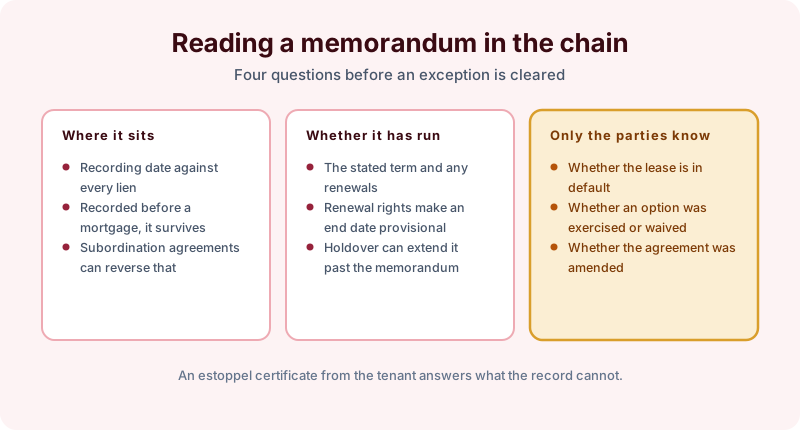
- Position. Compare the memorandum’s recording date against every lien of record. A leasehold recorded before a mortgage generally survives that mortgage’s foreclosure, which is the problem a lender solves with the instruments in our note on subordination and nondisturbance agreements.
- Whether the term has run. Read the stated expiration, then read the renewal rights, because an unexercised extension makes that date provisional. Holdover tenancies extend occupancy well past what the memorandum describes.
- Whether anything amended it. Lease amendments, assignments of lease, exercises of option and terminations are all recordable and frequently are not recorded. Their absence proves nothing.
- Possession on the ground. Someone in occupation under an unrecorded lease puts a purchaser on inquiry notice in most states, the doctrine our note on inquiry notice and unrecorded interests sets out. A memorandum is the recorded half of a question the ground answers.
Where the device shows up outside commercial leasing
Three other places, and each one carries the same risk of being read as the smaller document it resembles.
- Development and option agreements on raw land. A builder assembling a site records memoranda across several adjoining parcels. Some are exercised, some lapse, and almost none are released, so the index keeps showing them for decades.
- Solar and wind leases. These run forty years or more and reliably contain a purchase option plus a right of first refusal on any sale of the fee. Our note on solar and wind lease title research covers how the rest of the lease structure reads.
- Family and closely held transfers. A parent leases farmland to one child with an option to buy at a formula price. The memorandum is two paragraphs and the option outlives everyone who remembers agreeing to it.
What unites them is that the recorded notice is short, the underlying agreement is long, and the gap between the two is exactly where the money sits.
What the search returns, and what it cannot
We report every memorandum, lease, option, amendment, assignment and termination found of record, each with book, page and recording date, and we supply the full instrument rather than the index entry — because on this document type the index entry is actively misleading.
What a records search cannot establish is whether the lease is in default, whether an option was exercised or waived privately, whether the agreement has been amended by a writing nobody recorded, or what any of the economic terms are. Those require the underlying agreement and, in practice, an estoppel certificate from the tenant, the instrument our note on estoppel certificates describes. A search reports what was found of record in that county over the period searched; recording practice varies by county, and an empty index is not proof that no leasehold interest exists.
Working the file
Order the full instrument on every memorandum in the chain, not a summary. Read to the end of it looking for purchase rights. Then ask for an estoppel certificate before closing, since that is the only document that reconciles the recorded notice with the live agreement.
AFX Research conducts in-person searches, certified abstracts, and full document copies from any U.S. county — delivered in 12 to 72 hours and backed by our search guarantee.
Order a title search with document retrieval on the recorded memoranda, or compare our search products if you want the scope matched to the transaction first.