

· AFX Research
Lost Note Affidavits and Mortgage Enforcement in Title Research
What a lost note affidavit asserts, why the note never appears in the county record, and the gaps an attorney has to separate before a payoff or a foreclosure.

Table of Contents
A servicer demands payoff on a thirty-year-old mortgage, the borrower’s counsel asks to see the note, and what comes back is an affidavit swearing the note was lost. That document is doing a great deal of work. It is substituting sworn testimony for the single instrument that proves who is entitled to enforce the debt — and it is doing so in a transaction where the land record, which attorneys instinctively trust, has nothing to say about the question at all. Separating what the county can establish from what it cannot is the whole of the exercise.
The note and the mortgage are different animals
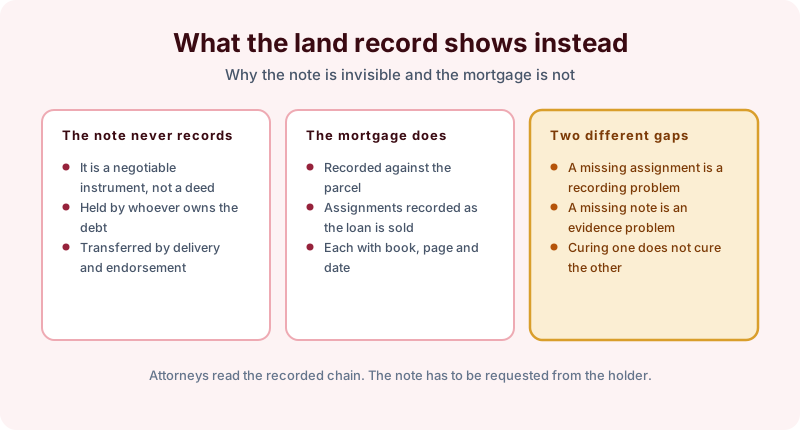
The promissory note is a negotiable instrument. It is the borrower’s promise to pay, it is held by whoever owns the debt, and it moves by physical delivery with an endorsement. It never reaches a recorder’s office, because recording is not what gives it effect.
The mortgage or deed of trust is the security instrument, and it does record. So do the assignments, each time the loan is sold, which is what produces the chain attorneys actually read. Our guide to the mortgage assignment chain and MERS sets out how that chain is built and where it breaks.
The distinction matters because the two produce different gaps, and they are cured in different places.
- A missing assignment is a recording problem. Somebody failed to file, and it is usually curable with a corrective or confirmatory instrument.
- A missing note is an evidence problem. Nothing filed in the county will fix it, because nothing filed in the county was ever the proof. The same split runs through our note on lost and destroyed deeds, where the instrument that vanished is the one the record did hold.
Curing one does not cure the other, and conflating them is the error that makes these matters expensive.
What the affidavit actually asserts
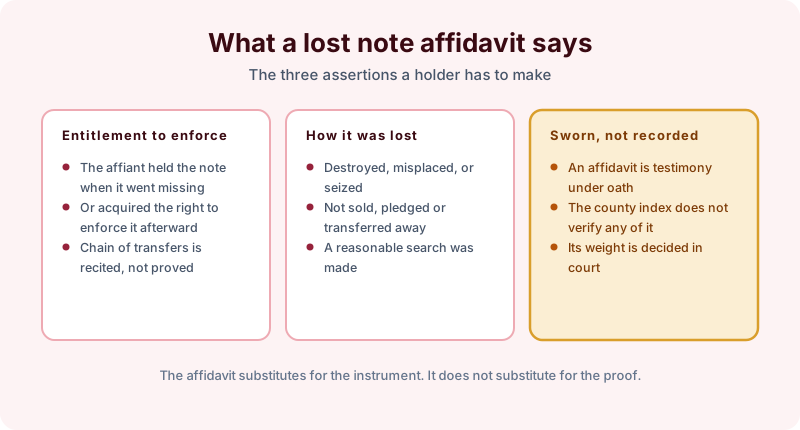
Most lost note affidavits track the Uniform Commercial Code’s requirements for enforcing a lost instrument, and they make three claims.
- Entitlement to enforce. The affiant held the note when it went missing, or acquired the right to enforce it from somebody who did. The chain of transfers is recited, not proved.
- The circumstances of the loss. The note was destroyed, misplaced or seized, and specifically was not sold, pledged or transferred away. A reasonable search was made.
- Adequate protection for the borrower. Many states require the enforcing party to post security or indemnify against a second demand by a later holder.
What it is not is a recorded document with independent force. It is testimony under oath, the county index verifies none of it, and its weight is settled in court rather than at the counter.
Where this surfaces in practice
Three situations account for most of them, and each has a different posture.
- Foreclosure. The lender must establish standing, and a lost note affidavit is the substitute. Several states require considerably more than the affidavit alone, and a few treat the question as jurisdictional. The checks in our foreclosure sale title research guide apply with extra force here.
- Payoff and release. A borrower refinancing wants the old lien discharged. The holder cannot produce the note but can record a release, and in practice that frequently resolves the title question even though it never resolved the evidentiary one. Our note on what a release of mortgage proves sets out what that filing does and does not settle.
- An ancient lien nobody will claim. The holder has dissolved, the servicer has no file, and nothing can be produced at all. That is the territory of our note on ancient mortgages and limitations, where a statute rather than an affidavit does the clearing.
What the title research can and cannot establish
We return the recorded record and we are precise about its edges. That means the mortgage or deed of trust with book, page and date; every assignment, modification, subordination and partial release in order; any lost note affidavit that was itself recorded, which some holders do file; and any recorded release or satisfaction, including one that may have been filed in error.
What a records search cannot establish is whether the note exists, who physically holds it, whether it was endorsed in blank, or whether it was pledged as collateral in a warehouse line. Those live in the loan file, and they decide the outcome far more often than the recorded chain does. Where a borrower is already in litigation, our work for property attorneys usually starts with the recorded chain and a deed retrieval on the instruments it names. A search reports what was found of record in that county over the period searched, recording and indexing practice varies county by county, and an empty result is not proof that no claim exists. Whether a particular affidavit satisfies a given state’s requirements is a legal conclusion for counsel, not an abstractor’s call.
Working the file
Pull the recorded chain first and read it for the gaps it can actually show. Then ask the holder for the note itself, with endorsements, before accepting an affidavit as the answer. Where the affidavit is the only thing on offer, confirm what security or indemnity the state requires, and check whether a release has already been recorded — which occasionally makes the whole dispute academic.
AFX Research conducts in-person searches, certified abstracts, and full document copies from any U.S. county — delivered in 12 to 72 hours and backed by our search guarantee, with the recorded instruments attached so the chain can be read rather than summarized.
Order a title search for the property and the period in question, or compare our search products if you are not yet sure how far back the chain needs to run.