

· AFX Research
Survivorship Affidavits and Proof of Death, 7 Title Checks
Title passes to a survivor without a deed, so the land record needs evidence instead. What the affidavit does, and the three times it does not settle the chain.

Table of Contents
- The deed already did the work
- When the affidavit does not settle it
- Seven checks before you rely on one
- 1. Read the vesting on the original deed
- 2. Confirm the state’s presumption
- 3. Search the chain between the deed and the death
- 4. Check the death certificate actually attached
- 5. Compare the legal description
- 6. Look for a competing instrument
- 7. Check who signed it
- What a search returns
- Order the records this actually takes
A joint tenant dies and the surviving owner holds the whole property from that moment. Nobody signs anything, nothing is filed, and the county index carries on naming a person who is dead. The affidavit of survivorship exists to close that gap, and it is one of the most frequently misunderstood instruments in a residential chain — including by the people who record them.
The deed already did the work
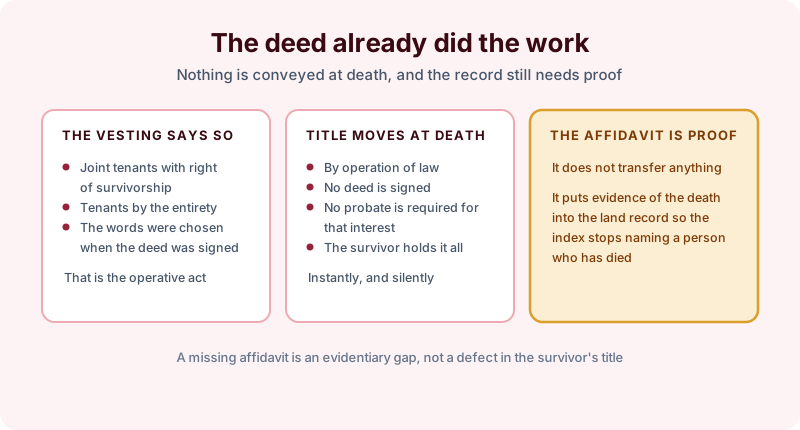
The operative act happened when the original deed was signed. Language creating a joint tenancy with right of survivorship, or a tenancy by the entirety between spouses, carries the consequence with it, and the survivor’s interest enlarges automatically at the moment of death.
That is why the affidavit transfers nothing. It is evidence, placed in the land record so that a later examiner can see why the index stopped matching reality. A missing affidavit is an evidentiary gap rather than a defect in the survivor’s title, which is a distinction worth making clearly to a client who has just been told their deed is “bad.”
The interaction with probate follows from the same point. A survivorship interest does not pass through the estate, so it is outside the administration entirely, which is the boundary drawn in probate property title research.
When the affidavit does not settle it
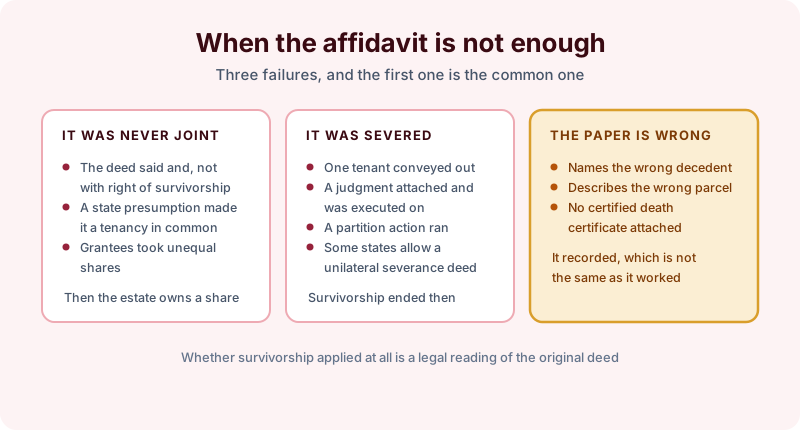
Three failures account for nearly all of the trouble.
The first and most common is that survivorship never applied. The deed said “A and B” without survivorship language, or a state presumption treated the grant as a tenancy in common, or the grantees took unequal shares. Then the decedent’s share passed through their estate, a surviving spouse may also have elective share rights on top of it, and the survivor holds half a property, which is the heirs problem taken up in heirs property and tenancy in common.
The second is severance before death. A joint tenant who conveyed out, a judgment creditor who executed, a partition action, or in several states a unilateral severance deed, each ends the survivorship. The chain looks continuous and the right disappeared years before anybody died, which is the mechanism set out in joint tenancy severance and survivorship.
The third is that the paper is simply wrong. Wrong decedent, wrong parcel, no certified death certificate attached. It recorded, which is not the same thing as it worked.
Seven checks before you rely on one
1. Read the vesting on the original deed
Not the affidavit’s recital of it. Pull the deed that created the co-ownership and read the granting clause, because the recital in an affidavit is the affiant’s characterization rather than evidence of what the deed said.
2. Confirm the state’s presumption
Several states presume a tenancy in common absent explicit survivorship language, and a few presume the opposite between spouses. The same words produce different results across a state line.
3. Search the chain between the deed and the death
This is the step most often skipped. Any conveyance, mortgage or judgment against one tenant in that window is a candidate severance, and the period can be forty years long.
4. Check the death certificate actually attached
A certified copy, naming the decedent as described in the deed. An affidavit reciting a death with nothing attached proves the affiant’s belief and little else.
5. Compare the legal description
Against the deed, not against the tax roll. A description retyped from an assessor record is how the wrong parcel ends up cleared.
6. Look for a competing instrument
A will devising the same interest, a transfer on death deed recorded later, or a trust conveyance. The relationship between those and survivorship is covered in transfer on death deeds, and survivorship generally wins, which does not stop the competing document from clouding the record.
7. Check who signed it
Most states allow any person with knowledge to make the affidavit, and some require the surviving owner. An affidavit sworn by a relative with no interest is weaker evidence, whatever the statute permits.
What a search returns
A records search reports the instruments found of record over the term searched, with certified copies, plus the probate and court records we are asked to pull. On a survivorship question that means the original deed, everything recorded against either tenant in the interval, the affidavit and whatever was attached to it.
Whether survivorship applied, whether it was severed, and whether an affidavit is sufficient evidence in that state are legal conclusions for counsel. Recording and indexing practice varies county by county, and an empty result is a statement about the index rather than proof that nothing happened.
Order the records this actually takes
AFX Research runs in-person searches, certified abstracts, and full document copies from any U.S. county — delivered in 12 to 72 hours and backed by our search guarantee. On a survivorship question that usually means the original vesting deed and the full interval behind it, not just the last two instruments.
Order a title search naming both tenants, or compare our search products to see which term fits.