

· AFX Research
Service by Publication and Title Research, 7 Attorney Checks
A judgment entered on defective publication service can be attacked years later. The recorded decree never shows it, and the court file always does.

Table of Contents
- What has to happen first
- The decree does not show any of this
- Seven checks on a chain that runs through a default
- 1. Identify the default
- 2. Pull the affidavit of diligent search
- 3. Confirm the order preceded the publication
- 4. Check where and how long it ran
- 5. Check who had to be served
- 6. Look for a motion to vacate
- 7. Test the purchaser’s position
- What a search can establish
- Order the file, not just the decree
Quiet title actions, judicial foreclosures, partitions and probate proceedings all share a problem. Somebody has to be given notice, and sometimes that somebody cannot be found. The answer the law supplies is service by publication, and a notice in a newspaper nobody reads is a thin substitute for actual notice. Courts know that, which is why publication carries requirements that are easy to get wrong and consequential when they are.
For a title examiner, the significant fact is that none of it appears on the recorded decree.
What has to happen first
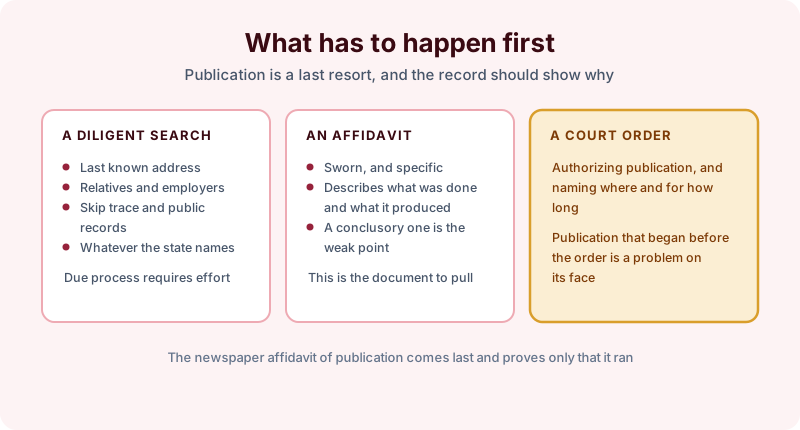
Publication is a last resort, and the record is supposed to show why it was reached.
A diligent search comes first. Last known address, relatives and employers, skip tracing and public records, and whatever else the state’s cases or statutes name. Due process requires genuine effort, not a formality.
An affidavit describes that search under oath. This is the document to pull, because it is where the weakness usually is. A specific affidavit listing what was done and what it produced is one thing. A conclusory recital that the defendant “cannot be found after diligent search” is considerably less, and courts have said so repeatedly.
A court order authorizing publication comes third, naming where and for how long. Publication that began before the order is a problem visible on the face of the file.
The affidavit of publication from the newspaper comes last and proves only that the notice ran. It is the least interesting document in the sequence and the one most often treated as the whole answer.
The decree does not show any of this
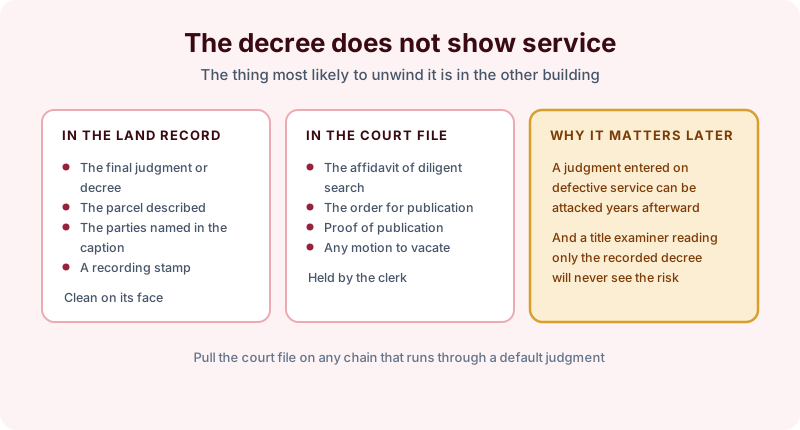
What reaches the land record is the final judgment, the parcel description and the parties named in the caption. It is clean on its face, it is indexed normally, and a title examiner reading only the recorded instrument has no way to see the risk.
The service record stays with the clerk of court. That split is structural rather than accidental, and it is the same division that makes quiet title actions and foreclosure sales worth examining in two offices rather than one.
The consequence is delayed. A judgment entered on defective service can be attacked long after it was entered, sometimes without a time limit where the defect goes to jurisdiction, and the attack lands on whoever holds the property by then.
Seven checks on a chain that runs through a default
1. Identify the default
Read the decree for language indicating that a defendant did not appear. That is the signal to order the file. A contested judgment carries much less of this risk.
2. Pull the affidavit of diligent search
Read it for specifics. Dates, sources consulted, addresses tried, results. If it recites a conclusion without the work behind it, that is the exposure.
3. Confirm the order preceded the publication
Compare the date on the order with the first publication date. Out of sequence is a facial defect.
4. Check where and how long it ran
Against what the statute requires and against what the order directed. Wrong newspaper, wrong county, or one week short all appear in the proof of publication.
5. Check who had to be served
Unknown heirs, lienholders of record, and anyone whose interest was recorded before the suit. A party omitted from the caption is generally not bound at all, which is the point made in partition actions.
6. Look for a motion to vacate
Already filed, already denied, or still pending. The file tells you whether somebody has tried, and what the court said.
7. Test the purchaser’s position
Where the property has since been sold, the question shifts to what a buyer knew or should have known, which is bona fide purchaser status, and in some states a curative statute or a marketable record title act may close the question on its own terms.
What a search can establish
A records search reports the instruments found of record over the term searched, with certified copies, plus the court records we are asked to pull. On a publication question that means the recorded decree, the lis pendens if one was filed, the deeds that followed, and the clerk’s file behind all of it.
Whether service was constitutionally adequate, whether a judgment is void or merely voidable, and whether a later purchaser is protected are conclusions for counsel. Recording and indexing practice varies county by county, and a clean recorded instrument is a statement about the recording rather than about the proceeding.
Order the file, not just the decree
AFX Research runs in-person searches, certified abstracts, and full document copies from any U.S. county — delivered in 12 to 72 hours and backed by our search guarantee. On a default judgment in the chain, the useful order is the land record and the court file together.
Order a title search with the court file included, or compare our search products to see which scope fits.