

· AFX Research
Pretermitted Heirs and Title Research, 7 Attorney Checks
A child left out of a will can take a statutory share that reduces a devise of real property. The deed looks clean, and the claim lives in the probate file.

Table of Contents
- How the statute reaches real property
- Why the land record cannot warn you
- Seven checks before you rely on a devisee’s deed
- 1. Read the will, not the deed’s recital
- 2. Build the family as of the execution date
- 3. Check adoption and non-marital status
- 4. Read the notice record
- 5. Confirm the claim period has run
- 6. Look for a settlement that never reached the recorder
- 7. Trace the deeds that ran afterwards
- What the search delivers and what it does not
- Order the records you actually need
Nearly every state has a pretermitted heir statute — a rule that a child born or adopted after a will was executed, and in some states a child simply left out of it, takes a share of the estate anyway unless the omission was clearly intentional. It is treated as a probate problem, and for most purposes it is. The difficulty for a real property attorney is that when the estate includes land, the statute reaches the land, and the deed that comes out the other side looks entirely ordinary.
How the statute reaches real property
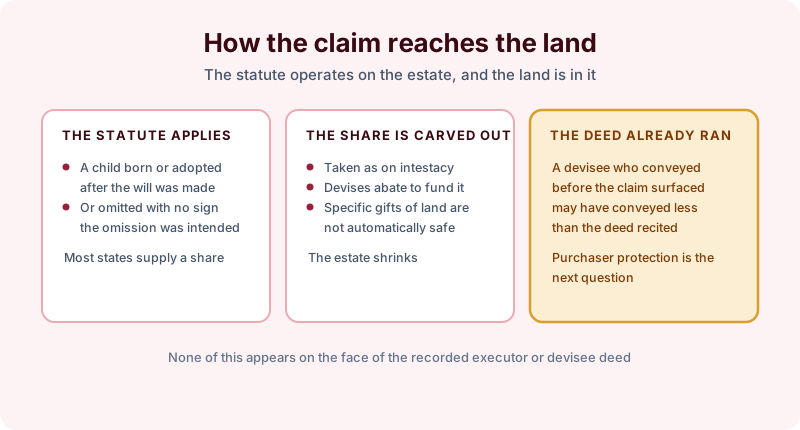
The mechanism is indirect, which is exactly why it gets missed.
The statute does not void the will. It gives the omitted child a share calculated as though the decedent had died intestate as to that child, and the estate has to fund that share from somewhere. Devises abate to pay it, and a specific devise of real property is not automatically insulated — the abatement order is statutory and varies by state, but land is in the pool.
The practical consequence runs through the chain. A devisee who took the house under the will, and conveyed it two years later to a buyer, may have held less than the will appeared to give. Whether that buyer is protected is a separate question, and it turns on the state’s recording act and on notice, the ground covered in recording acts and priority and in bona fide purchaser status.
Why the land record cannot warn you
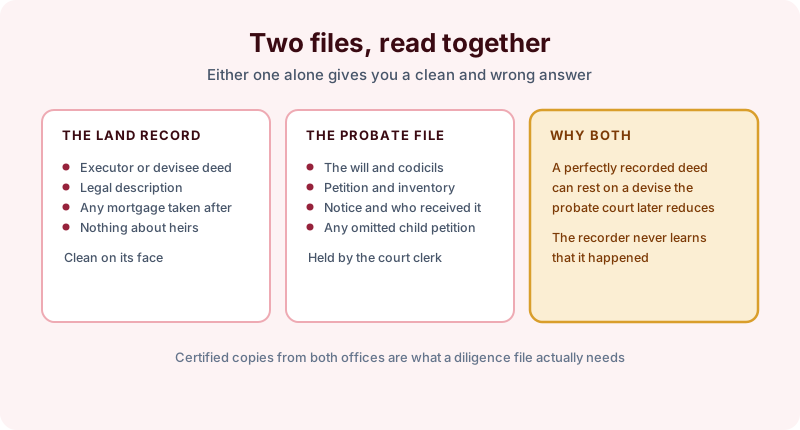
An executor’s deed or a devisee’s deed recites authority and describes the land. It does not recite the testator’s children, and it has no reason to. The recorder is not told who was born after the will was signed, who was adopted, or who filed a petition three counties away.
This is the same structural split that makes probate property title searches their own discipline. One office holds the conveyances. A different office holds the facts that decide whether the conveyances were sound.
Seven checks before you rely on a devisee’s deed
1. Read the will, not the deed’s recital
The recital says the grantor is the devisee under a will admitted on a date. Pull the will itself. What you are looking for is the date it was executed and whether it contains language expressly contemplating after-born or omitted children, which in most states defeats the claim.
2. Build the family as of the execution date
Children born or adopted after that date are the statutory target in the majority of states. A child alive and known when the will was signed, and still left out, is covered only in a minority of jurisdictions. The date is the hinge.
3. Check adoption and non-marital status
Adopted children are treated as children for this purpose in most states. A child whose parentage was established after death, or established in another proceeding entirely, raises the same question with none of the paperwork sitting in the probate file.
4. Read the notice record
Who was served, how, and whether anyone was noticed by publication. A claim raised by someone who never received actual notice is a different proposition from one raised by a party who sat through the whole administration.
5. Confirm the claim period has run
Every state limits the window, usually by reference to the probate proceeding rather than to the death. Confirm which event starts the clock in that jurisdiction and whether anything tolled it for a minor.
6. Look for a settlement that never reached the recorder
Omitted heir claims settle constantly, and the settlement frequently allocates cash rather than land so that the devisee keeps the house. That agreement is in the court file. Unless somebody recorded a deed or a release, the land record shows nothing at all, and deed retrieval on the parcel will come back looking settled.
7. Trace the deeds that ran afterwards
If the devisee conveyed, mortgaged or granted an easement before the claim surfaced, each of those instruments inherits the question. Wild deeds and breaks in the chain covers the related problem of an instrument that the index will not connect for you.
What the search delivers and what it does not
A records search returns the recorded instruments found over the term searched, with certified copies, plus the probate and court records we are asked to pull, which is the combined scope our property attorneys page describes. It will show you the executor’s deed, the devisee’s deed, every conveyance after it, and the petitions and orders in the estate file.
What it cannot do is tell you whether a claim is still live, whether the omission was intentional within the meaning of that state’s statute, or whether a particular purchaser took free of it. Those are conclusions for counsel, drawn from the documents. Recording and indexing practice varies county by county, and an empty result is evidence about the index rather than proof that nothing exists.
Order the records you actually need
AFX Research runs in-person searches, certified abstracts, and full document copies from any U.S. county — delivered in 12 to 72 hours and backed by our search guarantee. On an estate question that means the land record and the probate file together, because neither one answers it alone.
Order a title search with the estate file included, or compare our search products to see which scope fits the matter in front of you.