

· AFX Research
Equitable Mortgages and Deeds Absolute, 7 Title Checks
A deed that is really security for a loan reads as an ordinary conveyance in the index. What signals it, and why the grantee may have to foreclose.

Table of Contents
- What turns an absolute deed into a mortgage
- Why the land record will not tell you
- Seven checks when a chain looks like this
- 1. Price the deed against the record
- 2. Look for a deed back
- 3. Check who was in possession
- 4. Read the surrounding instruments
- 5. Search the grantee as well as the land
- 6. Pull any court file
- 7. Ask the parties for the companion documents
- What a search can and cannot establish
- Order the records behind the deed
A borrower needs money, a lender wants certainty, and instead of a note and a mortgage the parties sign a deed. The borrower conveys the property outright, with a private understanding that it comes back when the debt is paid. It is an old arrangement, it is still common in private lending, and courts have been unwinding it for roughly four centuries under the maxim that once a mortgage, always a mortgage.
For an attorney reading a chain of title, the problem is that it leaves behind a perfectly ordinary deed.
What turns an absolute deed into a mortgage
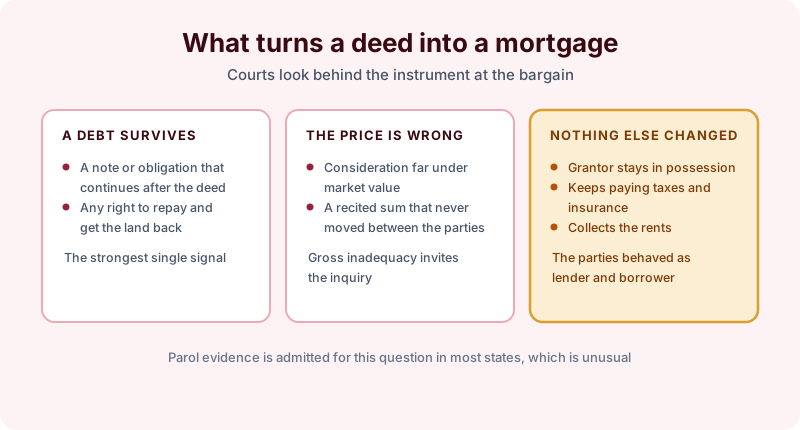
The doctrine is equitable and the inquiry is factual, which means courts look past the instrument to the bargain behind it. Three facts do most of the work.
The first is a surviving debt. If the grantor still owes the grantee something after the deed, and particularly if there is any right to pay it off and take the land back, the arrangement looks like security rather than a sale.
The second is price. Consideration far below market value, or a recited sum that never actually changed hands, invites the inquiry on its own.
The third is conduct. A grantor who stays in possession, keeps paying the taxes and the insurance, and collects the rents has not behaved like somebody who sold a building. In most states parol evidence is admissible to prove the real character of the transaction, which is a striking exception to the ordinary rule and the reason these cases turn on testimony rather than on documents.
Why the land record will not tell you
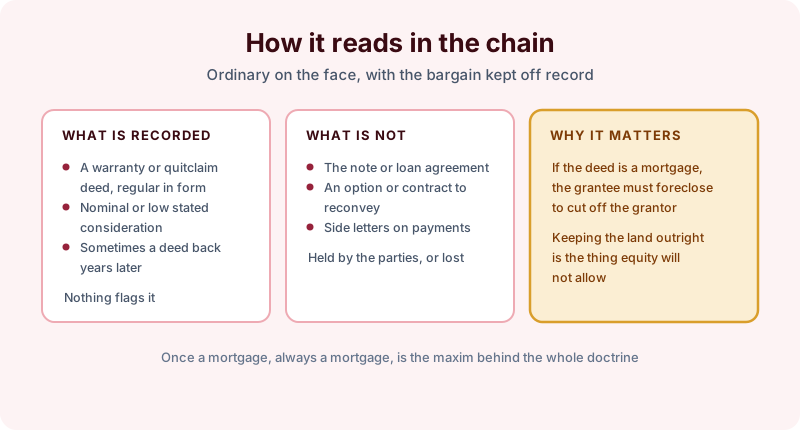
What gets recorded is a warranty or quitclaim deed, regular in form. What does not get recorded is the note, the option or contract to reconvey, and whatever side letters set the payment terms. The parties keep those, and often lose them.
The consequence is the part that matters commercially. If a court finds the deed was a mortgage, the grantee cannot simply keep the land when the borrower defaults. It must foreclose, with all the notice, redemption and surplus consequences that follow. A grantee who sold the property in the meantime has a considerably harder problem, and the purchaser’s position turns on bona fide purchaser status and on what the circumstances put them on notice of, the ground covered in inquiry notice and unrecorded interests.
Seven checks when a chain looks like this
1. Price the deed against the record
Compare the stated consideration, and any transfer tax paid, against assessed value in the same year. A transfer tax stamp consistent with a nominal conveyance where real value changed hands is worth a second look.
2. Look for a deed back
A reconveyance from grantee to grantor two or five years later, for similar nominal consideration, is the clearest possible signature of a security arrangement that ran its course.
3. Check who was in possession
Occupancy records, utility accounts and the tax bill mailing address frequently show that the grantor never left. Possession inconsistent with the deed is the classic trigger for inquiry notice.
4. Read the surrounding instruments
A mortgage, a lien release or a satisfaction recorded the same week as the deed often explains what the deed was doing. So does an assignment of rents given to the same grantee.
5. Search the grantee as well as the land
A private lender taking deeds as security usually does it more than once. Running the grantee’s name across the county is frequently how the pattern becomes visible, which is the technique described in locating a debtor’s real property.
6. Pull any court file
These disputes litigate. A quiet title action, a foreclosure, or a suit to declare a deed a mortgage will name the parcel, and the pleadings say plainly what the recorded deed does not. The quiet title action guide covers how those resolve.
7. Ask the parties for the companion documents
The note and the reconveyance agreement exist somewhere. Where a transaction is still being negotiated, asking for them is faster and more reliable than inferring their terms from the record.
What a search can and cannot establish
A records search reports the instruments recorded and found in the indexes reviewed over the term searched, with certified copies, and it will give you the deed, the consideration recited, the surrounding filings and any recorded reconveyance. Our note on nominee and straw party deeds covers a neighboring pattern that reads the same way in an index.
Whether a particular deed is in truth a mortgage is a conclusion a court draws on evidence, much of which is not in any public record. Recording and indexing practice varies county by county, and a chain that looks clean is a statement about the index rather than about the bargain.
Order the records behind the deed
AFX Research runs in-person searches, certified abstracts, and full document copies from any U.S. county — delivered in 12 to 72 hours and backed by our search guarantee. On a question like this it usually means the deed, everything recorded around it, and the court file if one exists.
Order a title search naming the parcel and both parties, or compare our search products to see which scope fits.