

· AFX Research
How a Disclaimer of Inheritance Changes a Property Chain, 7 Attorney Checks
A qualified disclaimer redirects real property as if the disclaimant predeceased. Here is what it leaves in the land record and what it does not.

Table of Contents
A disclaimer is one of the few instruments in estate practice that rewrites the past. When an heir or beneficiary executes a qualified disclaimer, the law treats them as having predeceased the decedent, and the property passes as though they were never in line for it at all. For tax planning this is elegant. For the person reading the chain of title three years later, it is a trap — because the deed that eventually records may name a grantee who appears nowhere in the will, and nothing in the land record explains why.
Property attorneys hit this most often in blended families, in Medicaid planning, and in estates where a creditor is circling one of the heirs. The mechanics are statutory and the deadlines are unforgiving, and the title consequences outlive both.
What a disclaimer actually does to title
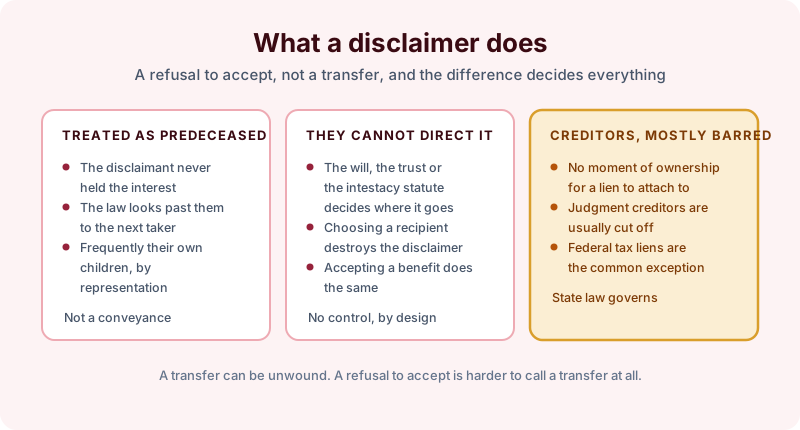
A disclaimer is a refusal to accept, not a transfer. That distinction carries almost all of the weight.
Because the disclaimant never accepted the interest, they never owned it, and three consequences follow.
- They cannot direct where it goes. The governing instrument or the intestacy statute does that.
- They cannot disclaim after accepting a benefit — collecting rent, signing a listing agreement, or taking a distribution will generally destroy the disclaimer.
- Their creditors, in most states, cannot reach the disclaimed interest, because there was no moment at which the debtor held it. Federal tax liens are the notable exception in many jurisdictions.
That last point is why a disclaimer so often appears in a chain alongside judgment problems, and why it sits close to the analysis in fraudulent transfer and voidable conveyance research. A transfer can be unwound. A refusal to accept is harder to characterize as a transfer at all.
Where it shows up in the record, and where it does not
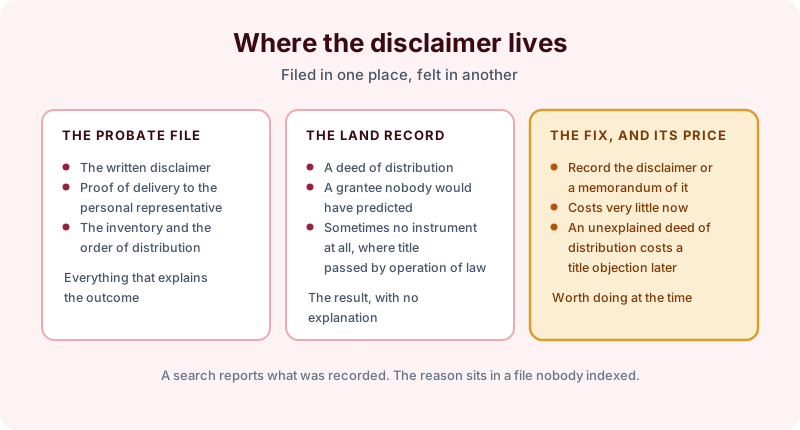
Here is the practical problem. A disclaimer is filed with the probate court and delivered to the personal representative. Recording it in the land records is good practice, and in many states it is optional.
So the land record may show any of the following.
- A deed of distribution from the estate to a grantee who is not the named devisee, with no bridging instrument.
- A deed from heirs whose names do not match the intestacy order a searcher would expect.
- Nothing at all, where the estate transferred by operation of law and no deed was recorded.
A search of the grantor and grantee indexes reports what was recorded and found. Where the disclaimer lives only in the probate file, the land record carries the result without the reason — which is exactly the shape of gap described in wild deeds and breaks in the chain.
7 checks before you rely on a disclaimed interest
-
Confirm the disclaimer is in writing, signed, and delivered. Statutes specify to whom — the personal representative, the trustee, the holder of legal title — and delivery is frequently where a disclaimer fails.
-
Check the timing against the governing statute. Federal qualified disclaimer treatment requires delivery within nine months of the transfer, and state law may set its own window. A late disclaimer may still be effective under state property law while failing for tax purposes, which produces a valid title result and an unwelcome gift tax one.
-
Look for acceptance. Any exercise of dominion before the disclaimer — depositing rent, paying the mortgage from estate funds in the disclaimant’s own name, listing the property — is an argument that the interest was accepted.
-
Trace where the interest actually went. Anti-lapse statutes, per stirpes distribution and the terms of a residuary clause all compete here, and the answer is frequently the disclaimant’s children rather than the other named beneficiaries. Minors complicate it further, since a guardian generally cannot disclaim on a minor’s behalf without court approval.
-
Search the disclaimant by name anyway. Judgments, state tax liens and federal tax liens docketed against them belong in the file even if the conclusion is that they never held the interest, and locating a debtor’s real property is the routine for it.
-
Pull the probate file, not just the land record. The disclaimer, the inventory, the order of distribution and any objection are all there, and the land record will not reproduce them, which is the same discipline probate property title research sets out.
-
Record a memorandum or the disclaimer itself where the statute allows. It costs very little and it removes the gap for the next searcher. An unexplained deed of distribution will cost somebody a title objection later.
The recurring failure, and how it reads
The pattern we see most is simple. An heir with exposure disclaims, the interest passes to their children, and the personal representative records a deed to the children. Five years on, a buyer’s searcher finds a deed from an estate to two grantees whose relationship to the decedent is not stated anywhere in the index.
At that point the options are to reconstruct the probate file, to obtain an affidavit, or to live with an exception. All three cost more than recording the disclaimer would have. The same economics drive corrective deeds and re-recording and heirs property and tenancy in common research.
It is also worth saying plainly what a search can and cannot settle. A records search reports what was recorded and indexed in that county over the term searched. It cannot tell you that a disclaimer was valid, that it was timely, or that the resulting distribution was correct. Those are legal conclusions for counsel in that state, and the role of the search is to put every recorded instrument in front of them with copies attached.
How AFX Research fits into this
Disclaimed interests are precisely the chains where a summary report fails and a document-level search earns its fee. AFX Research performs in-person searches, certified abstracts, and full document copies from any U.S. county — delivered in 12 to 72 hours and backed by our search guarantee — so the probate-era deeds, the names in the index and the instruments behind them arrive together rather than as a conclusion you have to take on trust.
Order a title search on the parcel and the names, or compare our search products if you are deciding between a current owner search and a full chain for an estate matter.