

· AFX Research
Simultaneous Death and Survivorship Deeds in Title Research
Survivorship needs somebody to survive. When joint owners die together, one estate becomes two and the list of people who must sign changes.

Table of Contents
- Why the order of death matters
- What the record will and will not say
- Where it gets harder
- Seven checks worth running
- 1. Read the survivorship language verbatim
- 2. Look for a survival clause
- 3. Establish whether either estate was opened
- 4. Search both names for liens separately
- 5. Check for anything recorded after the deaths
- 6. Identify every heir on both sides
- 7. Take the dates and the statute to counsel
- What to do with it
- Ordering the abstract behind the estates
A married couple holds the family house as joint tenants with right of survivorship, which is supposed to make things simple. They die in the same accident. Suddenly the arrangement designed to avoid probate has produced two estates instead of one, two sets of heirs, and a title question nobody can answer from the deed alone.
It is rare and it is not vanishingly rare, and when it happens the record is only half of the answer.
Why the order of death matters
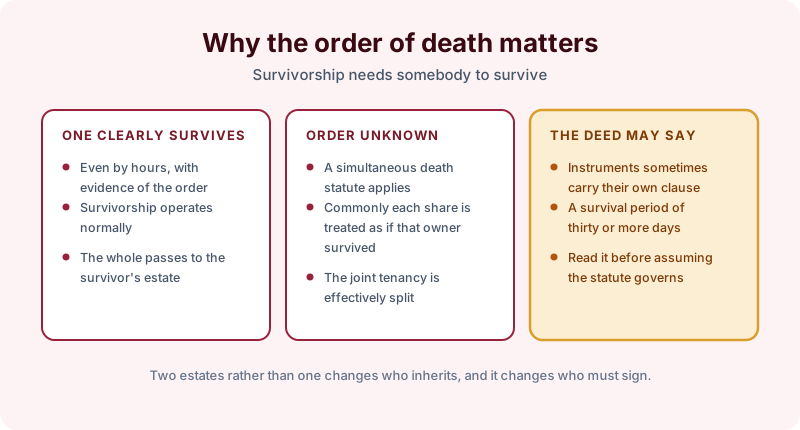
Survivorship works by somebody surviving. Where one owner clearly outlived the other, even by hours, and there is evidence of it, the whole passes to that survivor and then into their estate. One estate, one set of heirs.
Where the order cannot be established, a simultaneous death statute applies. Most states have adopted some version of the uniform approach, under which the property is generally treated as though each owner survived as to their own share. The joint tenancy is effectively severed, and the house splits.
The deed may also have its own view. Instruments and wills frequently carry a survival clause requiring a beneficiary to outlive the other by a stated period, commonly thirty days or more. Where one exists, it governs ahead of the default, so reading the instrument comes before reaching for the statute. That ordering is the same discipline applied in joint tenancy severance and survivorship.
What the record will and will not say
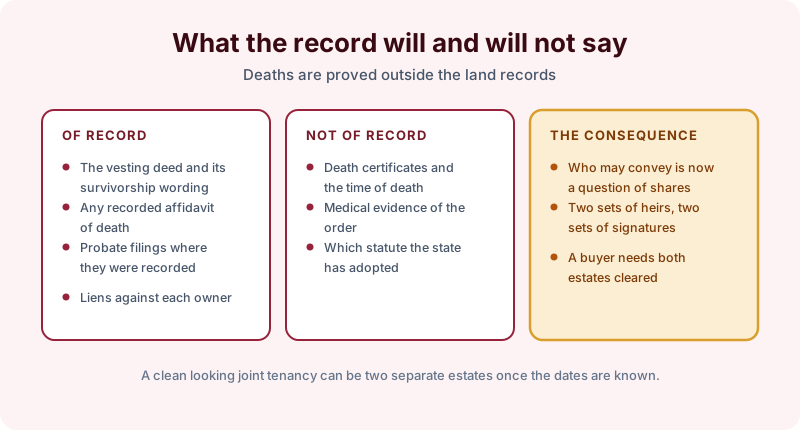
Of record you will find the vesting deed and its exact survivorship wording, any recorded affidavit of death, probate filings where that county records them, and liens against each owner individually — which now matter separately rather than jointly.
Not of record are the things the analysis actually turns on. Death certificates, the time of death, any medical evidence about the order, and which version of the statute that state adopted. None of it is in a land index.
The consequence is practical. Who may convey is now a question of shares, there are two sets of heirs and therefore two sets of signatures, and a buyer needs both estates cleared rather than one. A property that looks like a clean joint tenancy on its face can be two separate estates once the dates are known, which is the same discovery problem as heirs property and tenancy in common.
Where it gets harder
Three complications recur.
- A tenancy by the entirety between spouses may be treated differently from an ordinary joint tenancy under the statute, and the difference matters for creditors.
- A surviving spouse’s elective share can enter the picture on one side and not the other, which is the territory of elective share and surviving spouse rights.
- A life estate with a remainder does not behave like survivorship at all, and the two are routinely confused in older deeds, as life estate and remainder interest checks sets out.
Seven checks worth running
1. Read the survivorship language verbatim
Joint tenants with right of survivorship, tenants by the entirety, and tenants in common are three different outcomes, and older deeds use the words loosely.
2. Look for a survival clause
Thirty days is common. Where one exists it displaces the statutory default entirely.
3. Establish whether either estate was opened
A probate on one side and not the other tells you which family has already acted, and what they believed they inherited.
4. Search both names for liens separately
They no longer merge into one owner. A judgment against one now reaches a defined share.
5. Check for anything recorded after the deaths
An affidavit of death, a deed from one estate, or a sale that assumed survivorship operated. The last of those is the expensive one.
6. Identify every heir on both sides
Two estates means two sets of signatures, and a missing heir on either side stops a conveyance, as it does in a probate property search.
7. Take the dates and the statute to counsel
Order of death and which version of the statute applies are the inputs that produce the shares, and neither is a records question.
What to do with it
Pull the vesting deed and read the survivorship and survival language word for word. Search both owners’ names for liens, because they no longer merge. Check whether either estate was opened and whether anything was recorded against the parcel on either side. Then establish the dates and the statute with counsel, since that is where the shares come from.
A search reports what was recorded and found over the term searched, with copies attached. It cannot establish the order of death and does not determine the shares, and an empty result is not proof that nothing exists.
Ordering the abstract behind the estates
Two estates means twice the name searching and one parcel. AFX Research runs in-person searches, certified abstracts, and full document copies from any U.S. county — delivered in 12–72 hours and backed by our search guarantee.
Order a title search naming the parcel and both owners with every name variant, or compare our search products to pick the term that reaches the vesting deed itself.