

· AFX Research
Charging Orders Against an LLC Member, 7 Title Research Checks
A charging order reaches distributions, not the company's land. What the record still establishes, and why the dates on it decide the next motion.

Table of Contents
- What a charging order actually reaches
- Why the land record still matters
- Seven checks worth running
- 1. Search the entity under every name it has used
- 2. Search the debtor member individually as well
- 3. Run the affiliates
- 4. Date every conveyance out against the litigation timeline
- 5. Identify insider mortgages
- 6. Check for a recorded operating agreement or memorandum
- 7. Confirm the entity’s standing with the state
- What the record can and cannot settle
- Ordering the abstract behind the motion
A judgment creditor finds that the debtor owns nothing personally and that an LLC they belong to owns four parcels. The instinct is to levy on the land. In nearly every state that instinct is wrong, and the remedy the statute actually provides is a charging order — a lien on the member’s transferable interest, which is a much narrower thing than it first appears.
Understanding exactly how narrow is what makes the title research worth doing, because the record cannot help with the charging order itself and can help enormously with everything that comes after it.
What a charging order actually reaches
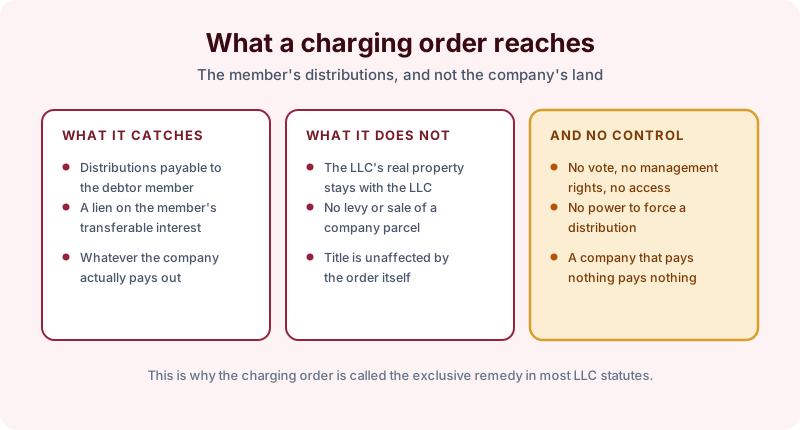
The order directs the LLC to pay the debtor member’s distributions to the creditor instead. That is the whole of it in most states.
It does not reach the company’s real property. The LLC owns that in its own name, the member owns an interest in the LLC, and those are different things — which is the entity-separateness point that also drives LLC and partnership property title research.
It also confers no control. The creditor gets no vote, no management rights, no right to inspect, and no power to compel a distribution. A closely held company whose members simply stop taking distributions can leave a charging order producing nothing at all for years, which is precisely why most LLC acts describe it as the exclusive remedy.
Why the land record still matters
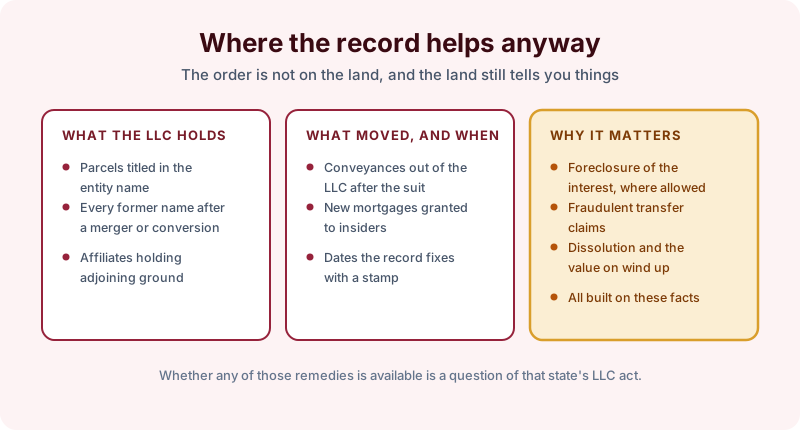
Three things follow from a search, and each one feeds a motion.
What the company holds. Parcels titled in the entity name, in every former name it used after a merger or conversion, and in affiliates that happen to own adjoining ground. That inventory is the starting point for valuing the interest at all.
What moved, and when. Conveyances out of the LLC after the suit was filed, new mortgages granted to insiders, and transfers to a related entity for nominal consideration. The record stamps each one with a date, and dates are the part of this that argues itself, exactly as in fraudulent transfer and voidable conveyance research.
What the next remedy needs. Whether foreclosure of the charged interest is available, whether dissolution can be sought, and what the interest is worth on a wind-up all rest on knowing what the company owns and what it owes.
Seven checks worth running
1. Search the entity under every name it has used
Formation name, post-merger name, post-conversion name, and the exact suffix. An index sorts on the string it was given.
2. Search the debtor member individually as well
Members routinely hold property outside the company, and a judgment enforcement search of the individual is a separate exercise from searching the entity.
3. Run the affiliates
Holding company, operating company, and the single-purpose entity formed for one parcel. These travel in groups, and the one holding the valuable parcel is rarely the one named in your judgment.
4. Date every conveyance out against the litigation timeline
Transfers after service, after judgment, or after the charging order was sought are the ones worth a second look.
5. Identify insider mortgages
A mortgage recorded to a member, a relative, or an affiliated entity reduces the value of everything behind it. Check whether it was ever funded.
6. Check for a recorded operating agreement or memorandum
Uncommon, and occasionally present on real-estate LLCs, where lenders sometimes required one. It can disclose transfer restrictions that bear directly on what a foreclosure of the interest would actually deliver.
7. Confirm the entity’s standing with the state
An administratively dissolved LLC that still holds title raises its own questions about who may convey, which overlaps with trust-owned property research and, where the entity was never properly wound up, with escheat and unclaimed real property.
What the record can and cannot settle
The land records establish what the entity holds of record, what is encumbered, and when each instrument was filed, with copies attached. They do not establish the membership, the terms of the operating agreement, or whether distributions are being withheld in bad faith — none of which is public.
Nor do they decide the law. Whether foreclosure of a charged interest is permitted, whether a single-member LLC is treated differently, and whether a transfer is avoidable are all questions governed by that state’s statute and for counsel to resolve. An empty result is not proof that nothing exists.
Ordering the abstract behind the motion
Charging order practice turns on entity names and recording dates, which makes full document copies rather than an index summary the useful deliverable. AFX Research runs in-person searches, certified abstracts, and full document copies from any U.S. county — delivered in 12–72 hours and backed by our search guarantee.
Order a title search naming the entity, every former name, and the individual member, or compare our search products to pick the term that reaches the transfers you need to date.