

· AFX Research
Attorney Liens on Real Property, 7 Title Research Checks
A fee claim can cloud a closing without ever being recorded. The three forms it takes, where each one surfaces, and what the land record will and will not show.

Table of Contents
- Three different things called an attorney lien
- Where each one surfaces
- Seven checks worth running
- 1. Search the client’s name, not just the parcel
- 2. Run every county where the client holds property
- 3. Look for domesticated judgments
- 4. Check the underlying court file where litigation produced the property
- 5. Ask whether proceeds are court-controlled
- 6. Read any recorded notice against its statute
- 7. Date everything
- What the record can and cannot settle
- Ordering the abstract behind the closing
A sale is three days from closing and a former attorney for the seller asserts a lien for unpaid fees. Nobody on the file has seen anything in the title report. Both facts can be true at once, and sorting out which kind of lien is being asserted is the whole of the analysis — because two of the three forms never touch the land records at all.
Three different things called an attorney lien
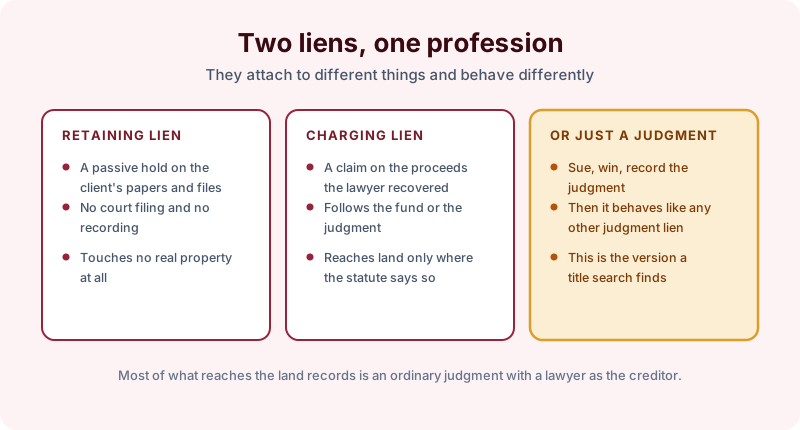
A retaining lien is a passive hold on the client’s own papers and files until the bill is paid. It is not filed anywhere, it is not recorded, and it has no bearing on real property. It is leverage, not an encumbrance, and a title officer who hears the word lien and reaches for the index will find nothing, correctly.
A charging lien is a claim against the proceeds the attorney’s work produced — a settlement fund, a judgment, sometimes the proceeds of a sale the litigation made possible. It follows the fund. Whether it reaches the real property itself depends entirely on that state’s statute and case law, and the answers vary widely. Some states confine it strictly to the recovery, some let it attach to property the recovery preserved, and a few require a separate filing before it binds anyone.
A judgment for fees is the third route and the one that actually shows up in a search. The attorney sues, wins, and records the judgment, at which point it behaves like any other judgment lien and sits in the priority order by its recording date, exactly as described in dormant judgment liens.
Where each one surfaces
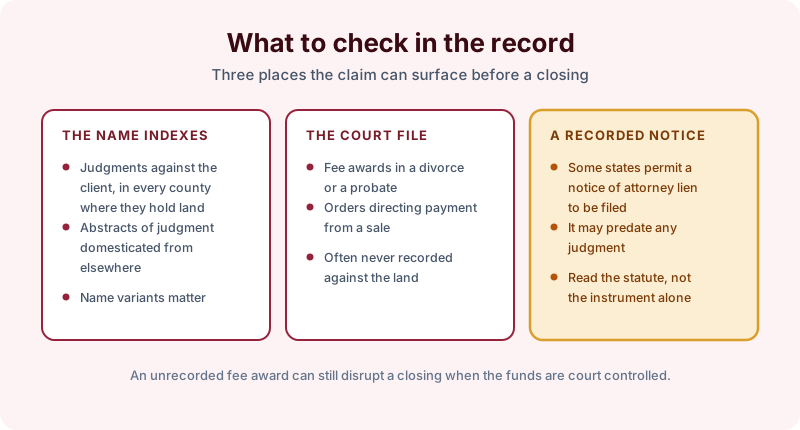
The name indexes carry recorded judgments against the client, in every county where that client holds land — and abstracts of judgment domesticated from another state, which is its own exercise in foreign judgments and domestication.
The court file carries everything else. Fee awards entered in a divorce, a probate, or a partition, and orders directing payment from the proceeds of a court-approved sale. These are frequently never recorded against the land, which is exactly why they surprise people at closing.
And a minority of states permit a notice of attorney lien to be recorded, sometimes before any judgment exists. Where that is available, the instrument appears in the land records and has to be read against the statute that created it rather than taken at face value.
Seven checks worth running
1. Search the client’s name, not just the parcel
Fee judgments attach to the person. The parcel search will not find one indexed only against a name you did not run.
2. Run every county where the client holds property
A judgment docketed in one county does not automatically encumber land in the next, and in several states docketing is a separate step from entry, with its own date.
3. Look for domesticated judgments
An out-of-state fee award becomes enforceable here only once domesticated, and the filing date governs priority.
4. Check the underlying court file where litigation produced the property
Divorce, probate, and partition proceedings routinely generate fee awards that live only in the docket. The property connection is set out in partition action title research and probate property title search.
5. Ask whether proceeds are court-controlled
Where a court approves the sale and disburses the proceeds, an unrecorded fee claim can still stop the money without ever clouding title. That is the scenario behind most last-minute closing failures of this kind, and it is invisible to a title search by design.
6. Read any recorded notice against its statute
A notice of lien filed where no statute authorizes one may be a wrongful lien, which raises the issues in slander of title and wrongful lien research.
7. Date everything
Recording dates decide priority between a fee judgment and the mortgage or the buyer, and the record supplies them.
What the record can and cannot settle
A search establishes what has been recorded against the parcel and the names over the term searched, with copies and recording dates attached. It does not establish whether a charging lien is valid, whether it reaches this particular property, whether the fee is reasonable, or whether an unrecorded award will be enforced. Those are legal questions governed by state law and for counsel. Recording practice varies by county, and an empty result is not proof that no claim exists.
Ordering the abstract behind the closing
Fee claims turn on names and dates more than on the parcel, which makes a thorough name search the part that matters. AFX Research runs in-person searches, certified abstracts, and full document copies from any U.S. county — delivered in 12–72 hours and backed by our search guarantee.
Order a title search naming the parcel and every name variant the client has used, or compare our search products to pick the term that reaches the judgment you are worried about.